Why Tailwind CSS Lost Traffic but Gained Users: The AI Effect
Explore how AI-driven coding tools slashed Tailwind CSS docs traffic by 40% and revenue by 80%, triggering massive layoffs despite soaring framework popularity.

Saurabh Jadhav
Author
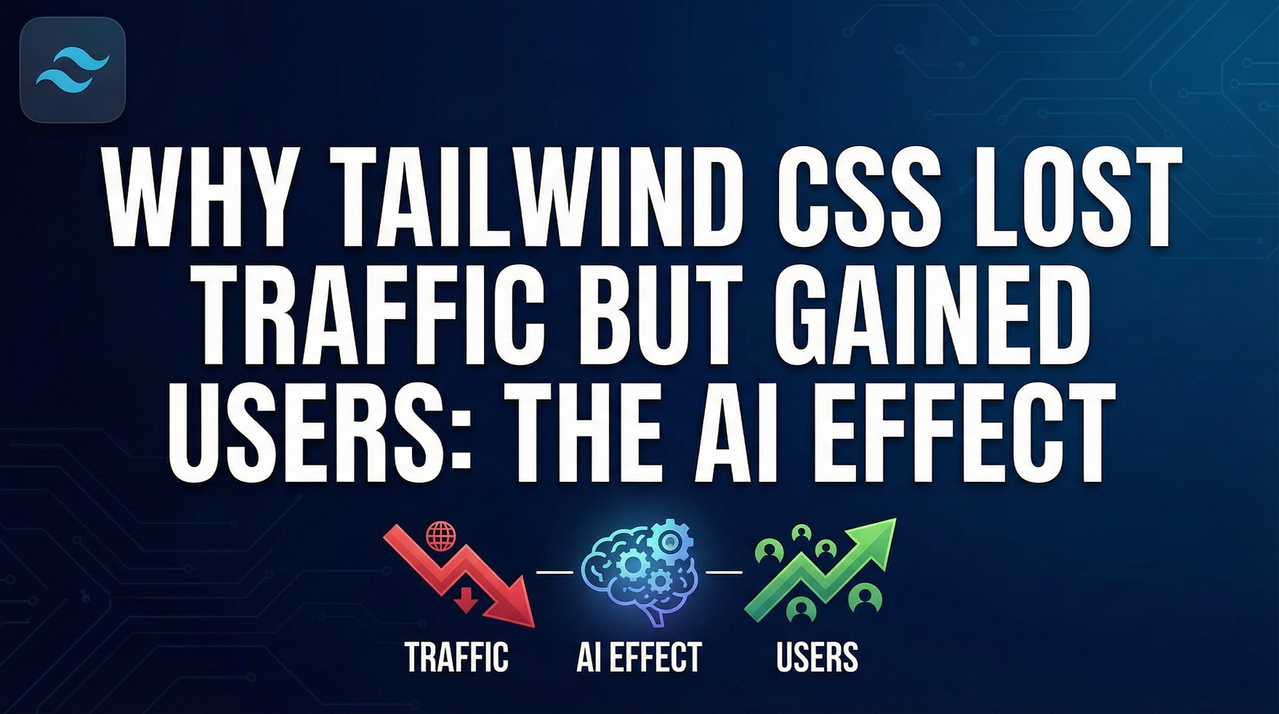
The Tailwind CSS Case: What AI Means for Tech Documentation
📊 The Numbers: 40% traffic drop. 80% revenue collapse. 75% of engineers laid off. Yet Tailwind CSS is more popular than ever. Welcome to the AI paradox.
In January 2026, Adam Wathan, founder of Tailwind CSS, made a statement that sent ripples through the developer community. Traffic to Tailwind's documentation had dropped by roughly 40% since early 2023, and he attributed this decline to one primary cause: AI coding assistants.
This wasn't just about numbers on a dashboard. Tailwind Labs laid off three-quarters of its engineering team, and Wathan publicly described it as "the brutal impact AI has had on our business." For a framework that's more popular than ever, seeing revenue collapse by 80% is a paradox that deserves closer examination.
What happened to Tailwind isn't just their story. It's a case study in how AI is fundamentally changing the relationship between developers and documentation.
When Success Doesn't Mean Survival
| Metric | Change Since Early 2023 | Status |
|---|---|---|
| Framework Usage | ⬆️ Growing faster than ever | Positive |
| Documentation Traffic | ⬇️ Down ~40% | Negative |
| Revenue | ⬇️ Down ~80% | Critical |
| Engineering Team | ⬇️ 75% laid off | Severe |
Here's the strange reality Tailwind faced: their framework was growing faster than ever. Developers loved it. Projects were adopting it at increasing rates. By every traditional metric of success, Tailwind CSS was winning.
Except for one crucial detail—almost no one was visiting their documentation website anymore.
The business model that powered Tailwind Labs depended on a simple funnel. Developers would visit the free documentation, learn about Tailwind CSS, and while they were there, discover premium products like Tailwind UI—pre-built component libraries that could save teams countless hours.
⚠️ The Breaking Point: AI coding assistants broke that funnel completely. When a developer asks GitHub Copilot or ChatGPT how to center a div with Tailwind, the AI simply answers. No visit to tailwindcss.com. No opportunity to discover premium offerings. No conversion.
Wathan was explicit about this in his GitHub comments. He even rejected a proposal to make Tailwind's docs more AI-friendly through an /llms.txt endpoint, arguing it would only accelerate the traffic decline. The irony was stark: making Tailwind easier to use through AI was making the business harder to sustain.
The Numbers Don't Lie
Third-party analytics backed up Wathan's claims. SimilarWeb data from December 2025 showed tailwindcss.com's global ranking slipping from around #14,879 to #16,156 over three months. Month-over-month traffic dropped by 4.8% between November and December 2025.
These weren't just estimates. Business Insider confirmed the figures: a 40% drop in documentation visits and an 80% revenue collapse over roughly the same period. The correlation between AI adoption and documentation traffic was becoming impossible to ignore.
But here's where the story gets more nuanced. SimilarWeb rankings are estimates, not perfect measurements. And while Tailwind's situation was dramatic, it wasn't clear if other framework documentation sites were experiencing the same fate.
A Pattern or an Outlier?
I looked for similar stories from other major frameworks. React? Nothing. Bootstrap? Crickets. No public statements from their maintainers about AI-driven traffic drops. No layoffs blamed on ChatGPT.
🔍 Framework Comparison
| Framework | Business Model | AI Impact Reported? |
|---|---|---|
| Tailwind CSS | Free docs → Paid components | ✅ Yes (40% drop) |
| React | Free (Meta-backed) | ❌ No reports |
| Bootstrap | Free core + Themes | ❌ No reports |
This raises an important question: is Tailwind's experience a preview of what's coming for everyone, or is there something unique about their situation?
The answer might lie in business models. React is backed by Meta and freely available—its documentation isn't a sales funnel. Bootstrap's core product is also free, with revenue coming from themes and templates sold elsewhere. Neither framework depends on documentation traffic to drive paid conversions the way Tailwind does.
Tailwind's vulnerability was structural. Their docs weren't just educational—they were the storefront. When AI bypassed the storefront, the entire business model crumbled.
What Developers Are Actually Doing
Developer surveys paint a more complex picture than the Tailwind case alone suggests. A Stack Overflow survey from December 2025 found that 68% of new learners still use official documentation as their primary learning resource. Yes, 44% reported using AI tools in the past year, but documentation usage remained strong.
📈 Developer Behavior: The Data
- 68% still use official docs as primary learning resource
- 44% reported using AI tools in the past year
- 75% would ask another person when AI fails
When AI fails or produces uncertain results, 75% of developers said they'd still ask another person for help. That "other person" often points them back to official docs or community forums.
Eric Holscher from ReadTheDocs offered perspective on this shift. While Q&A sites like Stack Overflow have seen dramatic traffic drops post-ChatGPT, he observed that "being 'official docs' for a project is a bit more resilient than a Q&A site" because documentation provides canonical reference information.
"In other words, AI is great for answering 'how do I center this div?' but less reliable for 'how does this framework's architecture actually work?'"
Research on developer behavior with AI tools confirms this split. Developers appreciate AI for rapid prototyping and debugging—tasks that previously required searching through documentation for specific syntax. But when it comes to understanding systems, learning new concepts, or verifying edge cases, they still turn to official sources.
The Workflow Transformation
✅ Old Developer Workflow
- Google search: "tailwind center div"
- Click through to documentation
- Find answer + syntax
- Discover Tailwind UI components
- Consider premium purchase
❌ New Developer Workflow
- Ask Copilot/ChatGPT: "center with tailwind"
- Get instant answer
- Done
The efficiency gain is obvious. The business impact is devastating.
The Google Factor
Google's own data adds another layer to this conversation. The company has denied claims of a broad traffic collapse due to AI chatbots. Their search leadership reports that overall organic click volume is "relatively stable" year-over-year, though traffic is redistributing—some resources lose audience while others gain.
This makes sense when you think about it. AI might satisfy simple queries without a click ("What's the Tailwind class for text-center?"), but for deeper or purchasing-related queries, users often still click through to sources.
| Query Type | AI Satisfaction | User Action |
|---|---|---|
| Quick Syntax | ✅ High | No click needed |
| Architecture Understanding | ⚠️ Medium | Often clicks to docs |
| Purchase Decision | ❌ Low | Always clicks through |
The difference is intent. If you're quickly styling a button, AI gives you the answer instantly. If you're evaluating whether to adopt a framework for a major project, you're probably still reading the documentation, comparing examples, and checking community discussions.
Tailwind's particular vulnerability was that their revenue model depended heavily on those quick, syntax-level queries—the exact queries AI answers best.
What This Means for the Future
💡 Key Insight
The Tailwind case doesn't mean documentation is dead. It means the role of documentation is changing. Documentation can no longer serve as the primary discovery mechanism for paid products.
Developers still need authoritative, canonical information. They still need to learn. They still need to verify what AI tells them. But the path to documentation is no longer linear. It's not "search Google → click docs → read → discover products."
Now it's more like:
- Quick tasks: "ask AI → get answer → move on"
- Complex tasks: "ask AI → verify in docs → dive deeper"
For companies building developer tools, this shift demands new thinking. If documentation can no longer serve as a discovery funnel, what can?
Emerging Adaptation Strategies
Build direct relationships beyond documentation
Go beyond reference materials
Create value beyond reference
Partner with AI tools directly
Wathan's resistance to making Tailwind more AI-friendly is understandable from a business perspective, but it might be fighting the inevitable. The question isn't whether AI will continue answering developer questions—it will. The question is how documentation creators and tool builders adapt their business models to this new reality.
The Broader Lesson
Tailwind's story is about more than CSS frameworks. It's about what happens when a technology becomes so good at answering questions that people stop visiting the source.
🎯 Any business model that depends on information asymmetry—where people must come to you to get answers—is vulnerable to AI disruption.
This pattern will repeat across industries. The frameworks that thrive will be those that either:
- Provide value beyond answering questions (community, support, guarantees)
- Monetize in ways that don't depend on documentation traffic
- Find new channels to reach developers that AI doesn't bypass
- Create products so differentiated that AI recommendations aren't enough
For now, documentation isn't going anywhere. Developers still need it, still use it, and still value it. But it's no longer the only—or even the primary—way developers get answers.
📊 The Documentation Paradox
| What's True | Documentation is still essential for deep learning |
| What's Changed | AI handles 80% of routine documentation lookups |
| The Impact | Traffic drops, but documentation value remains |
| The Challenge | Monetizing documentation-dependent business models |
Tailwind CSS was the canary in the coal mine. The coal mine is any information-based business model in the age of AI. The question isn't whether AI will change how people access information. It already has. The question is what comes next—and whether the frameworks, tools, and platforms we depend on can evolve fast enough to survive.
Join the Verse
Get exclusive insights on Next.js, System Design, and Modern Web Development delivered straight to your inbox.
No spam. Unsubscribe at any time.