Deepinder Goyal's Temple Device: The Neurotech Wearable Testing the Gravity Aging Hypothesis
Discover why Zomato CEO's Temple wearable went viral. The neurotech device testing if gravity affects aging explained.

Saurabh Jadhav
Author
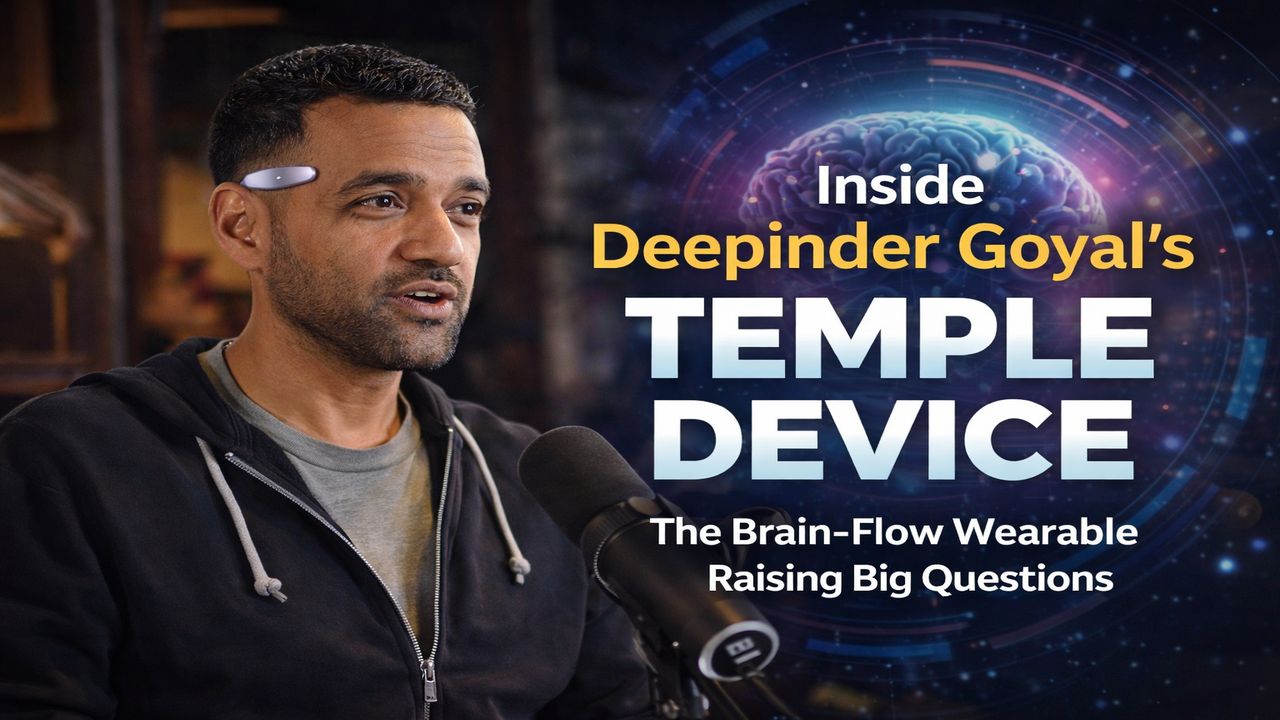
Inside Deepinder Goyal's "Temple" Device: The Neurotech Wearable Challenging How We Think About Aging
Published: January 5, 2026 | Reading Time: 8 minutes
The Viral Moment That Started a Conversation About Brain Health
On January 5, 2026, Zomato CEO Deepinder Goyal appeared on a podcast wearing something unusual. It wasn't a bold product launch or market prediction that caught attention—it was a small silver device clipped near his temple.
Within hours, screenshots flooded social media platforms. Initial reactions ranged from curiosity to confusion:
- Was it a hearing aid?
- A futuristic fashion statement?
- Some kind of medical device?
The truth turned out to be far more intriguing. The device, called Temple, represents an experimental approach to understanding aging through continuous brain monitoring—a concept that's now sparking debate across tech, medical, and longevity communities.
What Exactly Is the Temple Device?
Temple is an experimental neurotech wearable designed to continuously monitor blood flow to the brain. Unlike conventional health wearables that track heart rate or sleep patterns, Temple focuses specifically on cerebral circulation.
Key Features and Specifications
Design & Placement:
- Head-mounted device positioned near the temple region
- Lightweight, discreet form factor
- Designed for continuous wear
Monitoring Capabilities:
- Real-time cerebral blood flow tracking
- Continuous data collection (not periodic sampling)
- Focus on brain perfusion metrics
Current Status:
- Research prototype phase
- Not FDA-approved or medically certified
- Not commercially available
- Not affiliated with Zomato
How Temple Differs From Other Wearables
| Device Type | Primary Focus | Measurement Frequency |
|---|---|---|
| Smartwatches | Heart rate, activity | Periodic |
| Fitness bands | Movement, sleep | Periodic |
| CGMs | Blood glucose | Continuous |
| Temple | Brain blood flow | Continuous |
This makes Temple part of an emerging category: continuous neurotech monitoring for everyday use.
The Gravity Aging Hypothesis: Rethinking How We Age
Temple exists to test what Goyal calls the Gravity Aging Hypothesis—a provocative theory about aging's relationship with blood flow and gravity.
The Core Proposition
The hypothesis suggests that over decades, gravity's constant pull gradually reduces blood flow to the brain, potentially contributing to cognitive decline and aspects of aging.
The reasoning:
- Humans spend most of their lives upright
- The cardiovascular system must pump blood upward against gravity
- Even minor inefficiencies compound over 50-80 years
- Reduced brain perfusion may accelerate aging processes
Goyal's Personal Experiment
To test this hypothesis, Goyal has reportedly:
- Worn the Temple device for nearly a year
- Collected extensive personal longitudinal data
- Experimented with posture changes and inversion exercises
- Analyzed variations in cerebral blood flow patterns
This approach embodies a philosophy of "measure first, theorize second"—gathering data before drawing conclusions.
Why Is the Tech World So Interested?
Temple's viral moment reflects several converging trends in technology and health innovation.
1. The Rise of Consumer Neurotech
Brain monitoring has historically required hospital-grade equipment like MRI or PET scans. Temple represents an attempt to bring continuous brain-related monitoring into everyday life—similar to how continuous glucose monitors revolutionized diabetes management.
Market Context:
- The global neurotech market is projected to grow significantly through 2030
- Consumer interest in cognitive health is accelerating
- Brain-computer interfaces are moving from research labs to consumer applications
2. The Longevity Technology Movement
Longevity tech has emerged as one of the fastest-growing domains in healthcare innovation. Temple aligns with a philosophical shift from treating disease to preventing decline before it starts.
This preventive approach resonates with:
- Early detection advocates
- Biohackers and quantified-self enthusiasts
- Researchers exploring aging mechanisms
3. Founder-Led Deep Research
It's unusual for a high-profile CEO to personally test experimental technology for months and discuss unfinished hypotheses publicly. This transparency mirrors early-stage scientific exploration rather than polished product marketing.
Several tech founders and innovators have praised this curiosity-driven approach, calling it bold and refreshingly unconventional in an era of over-hyped product launches.
Medical Skepticism: What Experts Are Saying
Despite the enthusiasm in tech circles, the medical community has responded with appropriate caution.
Key Scientific Concerns
1. Measurement Accuracy
Medical experts note that true cerebral blood flow is typically measured using:
- Magnetic Resonance Imaging (MRI)
- Positron Emission Tomography (PET) scans
- Transcranial Doppler ultrasound
Surface-level sensors on a wearable device may only capture indirect or localized signals, raising questions about data validity.
2. Lack of Clinical Validation
Currently, there is:
- No peer-reviewed research supporting Temple's methodology
- No published clinical trials
- No independent verification of measurement accuracy
A senior medical expert from AIIMS Delhi publicly stated that the device lacks scientific credibility at this stage, emphasizing that experimental wearables should not be confused with validated medical tools.
3. The Data vs. Proof Distinction
As one researcher noted: "Data collection is not the same as scientific proof."
Even Goyal has acknowledged that Temple remains experimental and does not yet provide clinically meaningful insights.
Why Temple Matters (Even If the Hypothesis Is Wrong)
From an innovation perspective, Temple doesn't need to validate the Gravity Aging Hypothesis to be valuable.
The Real Contributions
1. Expanding the Boundaries of Wearable Tech
Temple demonstrates that continuous brain-related data collection outside laboratory settings may be feasible—even if current implementations are imperfect.
2. Raising Public Awareness
The viral attention has sparked conversations about:
- Brain health as a trackable metric
- The relationship between circulation and cognitive function
- Preventive approaches to neurological health
3. Encouraging Founder Experimentation
Many transformative technologies began as imperfect experiments:
- Early fitness trackers were inaccurate and bulky
- First-generation continuous glucose monitors faced skepticism
- Initial heart rate monitors were dismissed as unnecessary
Temple may follow a similar trajectory—or it may remain a niche research project. Either way, it has already pushed the conversation forward.
The Road Ahead: What's Next for Temple?
Current Status
As of January 2026:
- No public launch date has been announced
- No pricing information is available
- No regulatory approval pathway has been disclosed
- Early-access or research-only versions have been hinted at
Possible Future Scenarios
Scenario 1: Clinical Validation If rigorous studies confirm Temple's measurement accuracy, it could pave the way for FDA approval and mainstream adoption.
Scenario 2: Research Tool Temple may remain a specialized device for academic research or biohacking communities.
Scenario 3: Technology Licensing The underlying technology could be licensed to medical device manufacturers with regulatory expertise.
The Name Origin
Interestingly, the name "Temple" was suggested by a LinkedIn user, inspired by the device's placement near the temple region—a reminder of how organically this project has evolved through community input.
The Bigger Picture: Innovation at the Intersection of Biology and Technology
Temple represents something increasingly rare in modern tech: curiosity without immediate certainty.
The Uncomfortable Questions
The project forces us to consider:
-
Is aging purely biological, or partially mechanical? Could physical forces like gravity play underappreciated roles?
-
Can long-term brain data change preventive health? What happens when we can track brain metrics as easily as steps?
-
Should founders experiment publicly? Is there value in transparent, iterative development despite criticism?
A New Model for Health Innovation
Temple exemplifies a shift from:
- Polished product announcements → Transparent experimentation
- Marketing-driven launches → Data-driven exploration
- Short-term thinking → Long-term curiosity
This approach may not always succeed, but it creates space for genuine innovation.
Key Takeaways
✅ Temple is an experimental wearable designed to monitor brain blood flow continuously
✅ The Gravity Aging Hypothesis proposes that gravity's effects on circulation may contribute to aging
✅ Medical validation is absent but the concept has sparked important conversations
✅ The device is not commercially available and not a Zomato product
✅ Innovation value exists regardless of whether the core hypothesis proves correct
Final Thoughts: The Value of Ambitious Questions
Whether Temple becomes a breakthrough in neurotech or remains an ambitious experiment, it represents something valuable: the willingness to ask unconventional questions.
In an era where most tech products are iterative improvements, Temple stands out by exploring fundamental questions about aging, biology, and human health.
The scientific community's skepticism is healthy and necessary. But so is the curiosity that drives founders like Goyal to explore uncharted territory.
Sometimes, real innovation begins not with answers, but with better questions.
And Temple, for all its uncertainties, is definitely asking interesting ones.
Frequently Asked Questions
Q: Can I buy the Temple device? No, Temple is currently a research prototype and not commercially available.
Q: Is Temple a Zomato product? No, Temple is Deepinder Goyal's personal experiment and is not affiliated with Zomato.
Q: Is the Gravity Aging Hypothesis scientifically proven? No, it remains an unvalidated hypothesis without peer-reviewed clinical evidence.
Q: How accurate is Temple's brain monitoring? The accuracy has not been independently verified or published in scientific literature.
Q: Will Temple get FDA approval? There is no public information about regulatory approval plans.
Stay updated on emerging neurotech and longevity innovations. Subscribe to our newsletter for weekly insights into the future of health technology.
Related Topics: #Neurotech #Longevity #Wearables #BrainHealth #HealthTech #Innovation #DeepinderGoyal
Join the Verse
Get exclusive insights on Next.js, System Design, and Modern Web Development delivered straight to your inbox.
No spam. Unsubscribe at any time.